
Tribes, tribes, and more tribes

I find that I navigate in a variety of different tribes, each with it’s own unique characteristics.  Some large, some small, and some in between.  I feel a part of some tribes because of our common activities.  I feel a part of others because of a common interest.  And still others because of my proximity to the people in the tribe.  Each has it’s own rules for admittance, dress codes, agreed upon language, and ways of thinking.  But there are also commonalities that are important to all of the tribes – engagement with the tribe, a desire to support the tribe, and a willingness to interact with others in the tribe.
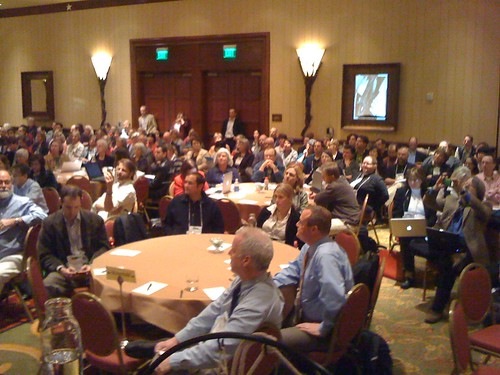
https://c1.staticflickr.com/5/4030/4289437205_524cc69b31.jpgFor many years I’ve attended conferences hosted by Educause, an organization for IT administrators in higher education.   Talk about hanging out with my tribe…5000 IT administrator geeks all talking about our common experiences.

https://i0.wp.com/www.gannett-cdn.com/-mm-/ad24fa7d8aa03201ba5ee7e815247450897a106e/c%3D264-0-2736-1854%26amp%3Br%3Dx404%26amp%3Bc%3D534x401/local/-/media/Phoenix/Phoenix/2014/06/08//1402249109000-US.jpg

And then there is my soccer tribe … people with the same passionate interest in “the beautiful game”. When I first got interested in soccer, it was with a small tribe in my neighborhood.  But now, I feel like I’m in a tribe of millions.

 And thanks to my sons, I’m also deeply invested in my tribe of boy scouts.  Gathering together to talk knots, backpacking, first aid, and a variety of other skills, we openly accept new members, but only if they are willing to work beside us to achieve our goals.

And now I’m venturing into a new tribe with my work in instructional and learning technologies.  Learning how to walk the walk and talk the talk.  I’ve found that within this larger tribe I have a special interest in big data in education, which is where I am headed with my Networked Learning Space (NLS).  I’m hoping find my voice within this community, and bring others along with me.
Early warning system at Purdue

I’ve been very interested lately in learning data analysis and the use of the data to predict student success or failure in a class or program of study.  I am especially interested in the idea that interventions based on the predictive data can possibly be used to help students succeed.  This blog post is from a Google+ community called Learning Big Data Hangout as seen below:

signals.PNG

It is an article in EducationDive describing a program at Purdue University called “Signals” where they don’t actually predict student outcomes, but they flag previously unsuccessful behavior and send warnings to the students if they see them doing the same type of behavior again.  It’s described as, ” giving current students the benefit of an early warning” and the data indicates that students participating in the program have a 20% higher graduation rate than other students, although these numbers are still being debated.

A Fresh Look at Adaptive Learning

I’m still wandering through the world of big data and it’s use in adaptive learning.  I ran across this twitter post that highlighted a blog post at ELTjam, a great blog for teaching English with an emphasis on using technology (check out my resources page).  Here is the twitter post with a link to the blog post:

Alearning2.PNG

I found the post interesting because it introduced me to the idea of adaptive content, classroom, and curriculum as a new way to think about adaptive learning.  I immediately connected with the following statement from the post, ” Upon completion of a given activity, the system directs the student to the next activity. That is not adaptive learning, but rather adaptive content; it is the content sequence (of “activities”) that adapts to the learner’s past performance.”  It’s a fresh way to think of a hot topic in eLearning.

Canvas community: the possibilities are endless.

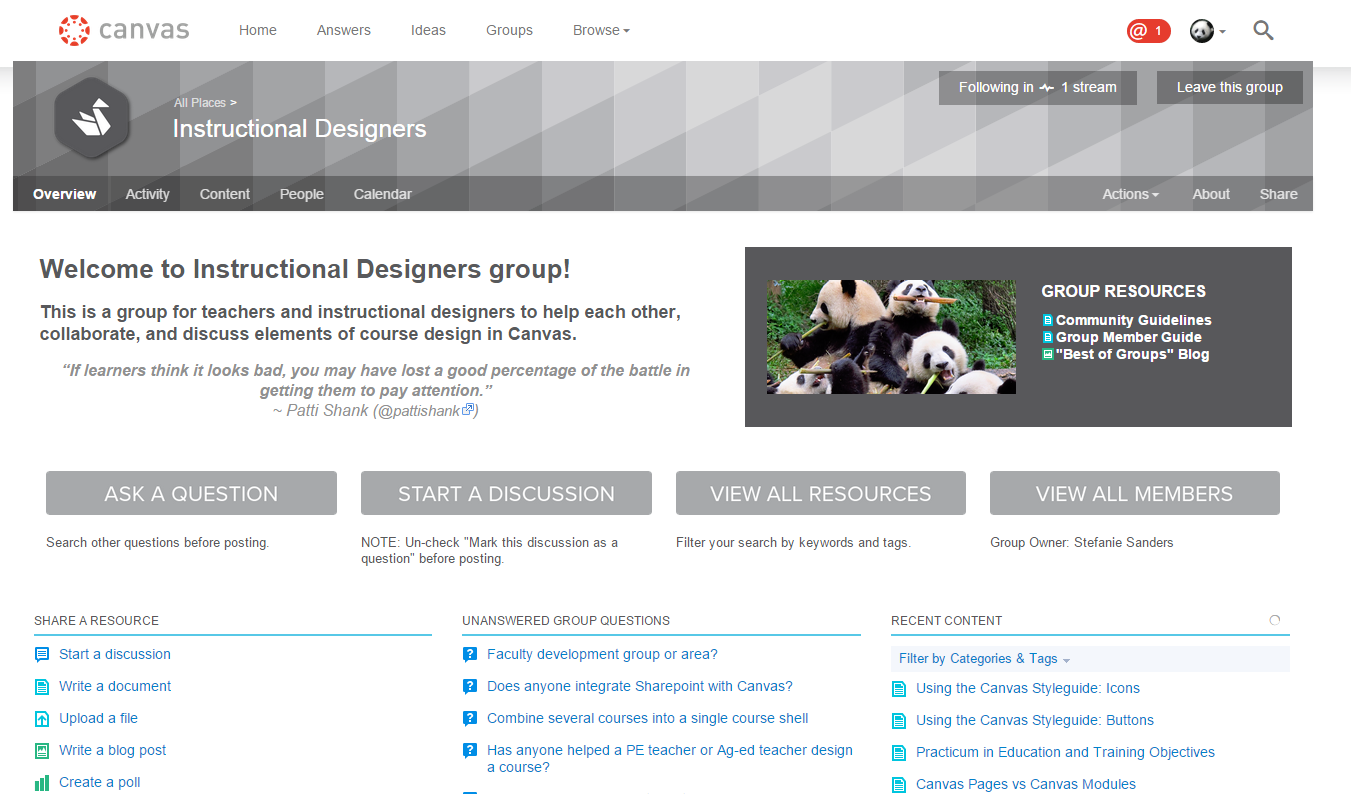
I’ve recently joined the Canvas Community as a way to get ideas and information about a system that is new here at Virginia Tech.  We recently adopted Canvas as the LMS of choice (the announcement), and now it’s up to the Instructional Designers and the IT people in the colleges to figure out how to make it work for our faculty and staff.  So it was great to see all of this information in one place:

Canvas community

Started working my way through the Community and it’s already paying off for me.  One of the projects that I’m working on is how to integrate Microsoft’s OneNote into Canvas as a tool for storing information, documents, etc.  And within minutes I found an important bit of information (Integrate Onenote with Class Notebook) about the integration that could have taken me hours of research to locate on my own.

I’m looking forward to using this community to learn more about Canvas, to share ideas that I develop, and to help my faculty and staff survive the transition to the new LMS.  The possibilities are endless.

Rewired: does connectivism rewire the brain?

I’ve been interested in the physical affect on our brain from the use of technology.  I don’t want to get too immersed in the details, but an important part of our memory is something known as ” long term potentiation” Link which basically states that the more we use a connection between memories (or neurons), the more significant the memories are to us. So if we don’t use connections in the brain as much because we can use technology to find important information, then the pathways in our brain are physically changing or rewiring.  This goes back to an earlier conversation about not remembering phone numbers because we have them stored in our smart phones.  We don’t rely on the simple path of, “what is the number for Sam”, but we now rely on a different (and I would argue much more complex) path of, “how do I work this device to get the number for Sam”.

When I first read about Siemen’s Theory of Connectivism I immediately thought of this model of how memory works.  It’s not so much about how I learn simple facts, but technology has changed it to the more complex question of how do I learn to connect to outside sources of information so that I can know the fact, plus the history of it, or the origination of the word, or any number of related topics if I decide they are important to me.  It becomes less important that I know the fact, and more important for me to know how I connect to a reliable source for the fact.  And the more often I use certain connections, the more significant they are to me.  Or as Siemens stated, “Know-how and know-what is being supplemented with know-where (the understanding of where to find knowledge needed)” Link.

LinkedIn as a source to reconnect

linkedin

I’ve been on LinkedIn for quite a while now.  I originally joined because a former employee/colleague/friend that I liked and respected sent me an invite (over 6 years ago).  I’d never heard of LinkedIn prior to that, but after checking it out a bit, I thought sure, why not.  I thought it was probably just one of those fad sites that pop up and then disappear every so often, but if it kept me in touch with my friend then it would be worth a try . I filled in my profile information and didn’t do much else with it for a number of years except for accept the occasional invite.  I think I started to realize the power of LinkedIn as a social network when I started getting invites and having conversations with former colleagues that I hadn’t heard from for over 15 years.  It started to become a way that I could keep in touch with these people, with my oldest contact now being with someone I worked with back in 1984, and hadn’t heard from for many, many years.  It’s great because I can get a view of their lives by following where they’ve worked, where they’ve lived, and sometimes quite a bit more information based on what they have on their profiles.  And I’m guessing that they probably do the same with me.

LinkedIn has also become a point of contact for colleagues who I’ve known recently, and on a number of occasions I’ve used it to help some of these people advance their careers, which gives me great satisfaction.  Recently, I had a friend and colleague who moved to India, and he was up for a big promotion at the company where he worked.  He was able to contact me through LinkedIn and arrange for an endorsement from me as a former supervisor.  It worked out that he was able to arrange an interview between me and his new boss, which ended up in him getting the job.  So through the use of LinkedIn I was able to help someone that I really wanted to help.